As of January 1, 2026, an undisclosed AI-altered listing photo is a misdemeanor in California. That is not a typo. The state's AB 723 turned a long-standing ethics expectation into criminal law, and other states are moving in the same direction.
The rules are now a patchwork of NAR ethics standards, individual MLS policies, and a growing set of state laws, and they no longer stop at staged photos. AI-generated listing video is squarely in scope. This guide covers who requires what, how the rules differ by state, and the fastest way to stay compliant without slowing down your marketing.
This is general information, not legal advice. Disclosure rules vary by MLS board and change quickly, so confirm the specifics with your MLS and your broker or attorney before you rely on them.
Do you have to disclose virtually staged photos?
Yes. Disclosure is required by the NAR Code of Ethics, many MLS boards, and a growing list of state laws. Article 12's duty to present a true picture of the property prohibits misleading listing content, and NAR guidance applies that duty to altered and AI-generated images (National Association of Realtors, Case Interpretations Related to Article 12).
This matters because staging works. In 2025, the National Association of Realtors found that 49% of sellers' agents saw staging cut a home's time on the market, and 83% of buyer's agents said staging makes it easier for buyers to picture a property as their future home (National Association of Realtors, Profile of Home Staging, 2025). Virtual staging extends that advantage to every listing, not just the ones with a staging budget.
So the goal is not to avoid staging. It is to stage honestly. Is virtual staging legal? Yes. NAR does not ban virtual staging; it requires that every enhanced photo still present a true picture of the property. Add furniture, yes. Hide a water stain or a cracked wall, never.
For the mechanics of staging a room from a photo, see our guide on how virtual staging works. This post focuses on the part that creates liability: disclosure.
What does California's AB 723 require?
California's AB 723 took effect on January 1, 2026, and it is one of the strictest digitally-altered-photo laws in the country. It requires two things for any altered listing image: a reasonably conspicuous statement, on or adjacent to the image, that the image has been altered, plus a link, URL, or QR code that points to the original, unaltered photo (California Legislature, AB-723 Real estate: digitally altered images: disclosure).
In 2026, AB 723 also made non-disclosure a misdemeanor, the first state law to attach a criminal penalty to undisclosed alterations (Lewis Brisbois, New California Law Requires Real Estate Agents to Disclose AI Alterations, 2026). The exposure is concrete: a violation of California's Real Estate Law is a misdemeanor punishable by a fine of up to $1,000 or up to a year in county jail, and the Department of Real Estate can separately issue a citation carrying an administrative fine of up to $2,500 per violation, or suspend or revoke the license (California DRE, Citations and Administrative Fines, 2025; California Senate Judiciary Committee, AB 723 Analysis, 2025). It applies to agents, brokers, and anyone acting on their behalf, which includes the software and services you use.
For a plain-English reference on each rule, we maintain a directory of AI disclosure laws and MLS policies with a detail page per law.
What counts as "digitally altered"? Adding furniture, removing clutter or damage, changing wall colors or flooring, swapping skies, or adding landscaping all qualify. What does not: routine adjustments like lighting, cropping, white balance, sharpening, or straightening that do not change how the property is represented. For a deeper breakdown of the statute, who it covers, and the penalties, see our full explainer on California AB 723.
AI-generated video is the disclosure gap most agents miss
AI-generated listing video carries the same disclosure duty as a staged photo, and almost nobody is labeling it. The NAR obligation to present a true picture of the property does not care whether the output is a JPEG or an MP4, yet most state photo rules and MLS policies were written before AI video was common. The duty still applies; the habit has not caught up.
The catch is that platform watermarks do not hold. When OpenAI's Sora launched, testers found its built-in AI watermark could be stripped in seconds with widely available tools (Inman, How AI Video Is Testing Our Trust, 2025). A disclosure that can be removed is not a disclosure. The reliable approach is a label burned directly into the video frame, so it travels with the file to the MLS, Instagram, or anywhere else it lands. For the full breakdown of labeling synthetic video, see our guide to AI real estate video disclosure.
There is a second compliance layer worth naming. The Fair Housing Act applies to AI-generated marketing content, and HUD confirmed in 2024 that AI-produced listing copy and imagery can trigger steering and discrimination liability (HousingWire, HUD issues Fair Housing Act guidance on AI use, 2024). Disclosure is necessary, but it does not excuse content that misrepresents or discriminates.
What are the disclosure rules by state?
The rules are not uniform, so your obligations depend on where the property sits, and California is no longer alone. Wisconsin's Act 69 becomes the second state AI-altered-advertising disclosure law when it takes effect on January 1, 2027, enforced by the Real Estate Examining Board with forfeitures of up to $5,000 per violation (Wisconsin Legislature, 2025 Act 69). In November 2025, the New York Department of State warned that misleading AI-generated listing images already violate existing advertising rules, which carry a fine of up to $2,000 per violation under Real Property Law 441-c (NY Department of State, trend alert on AI-generated listings, 2025). Texas, through TREC, requires that virtual staging be disclosed "clearly and conspicuously," backed by administrative penalties of up to $5,000 per violation, while its broader AI law (TRAIGA) is enforced separately by the Attorney General. Colorado is a cautionary tale in how fast this area moves: its original AI Act (SB 24-205) was stayed and narrowed before the first version ever took effect (Colorado General Assembly, SB24-205). Most other states default to NAR guidance plus local MLS policy.
| State | Rule | What it requires | Penalty |
|---|---|---|---|
| California | AB 723 (Jan 1, 2026) | Label on image + link to original | Misdemeanor; DRE citation up to $2,500/violation |
| Wisconsin | Act 69 (Jan 1, 2027) | Disclose AI-altered advertising | REEB forfeiture up to $5,000/violation |
| New York | DOS guidance (2025) | Honest, accurate advertising | DOS fine up to $2,000/violation |
| Texas | TREC + TRAIGA | "Clear and conspicuous" disclosure | TREC penalty up to $5,000/violation |
| Colorado | AI Act, since narrowed | AI-use transparency | Civil enforcement |
| Most others | NAR + local MLS | Label altered images | MLS fines, ethics complaints |
Because the floor is set by your MLS and the ceiling by state law, the practical move is to design one disclosure habit that satisfies the strictest rule you might touch. If you ever market California property, build to AB 723 and you are covered nearly everywhere else.
For agents tracking how MLS distribution itself is shifting, our post on brokerages moving listings off the MLS covers the wider context.
How to disclose correctly: the label and the original
Two steps cover most obligations. First, put the disclosure on the media, not just in the remarks. Many MLS boards, and AB 723, require the label to appear on or directly adjacent to the image, and a note hidden in agent remarks alone is frequently not acceptable (Canopy MLS, Digital, Virtually Staged, and AI-enhanced Images, 2026).
Second, keep the original reachable. Several boards require a non-staged version of the image to sit immediately before or after the altered one, or to be accessible by link (SDMLS, AB 723: Digitally Altered Images Requirements, 2026). AB 723 makes this explicit with its URL-or-QR requirement.
A simple checklist that holds up across boards:
- Label on the image. Burn "Virtually Staged" or "AI-Generated" text onto the photo or video frame.
- Keep the original accessible. Provide the unaltered image alongside, or a link or QR code to it.
- Note it in remarks too. Use listing remarks as a backup, never as the only disclosure.
- Apply the same rule to video. In-frame label, not a strippable watermark or caption.
How does Reel Estate handle disclosure automatically?
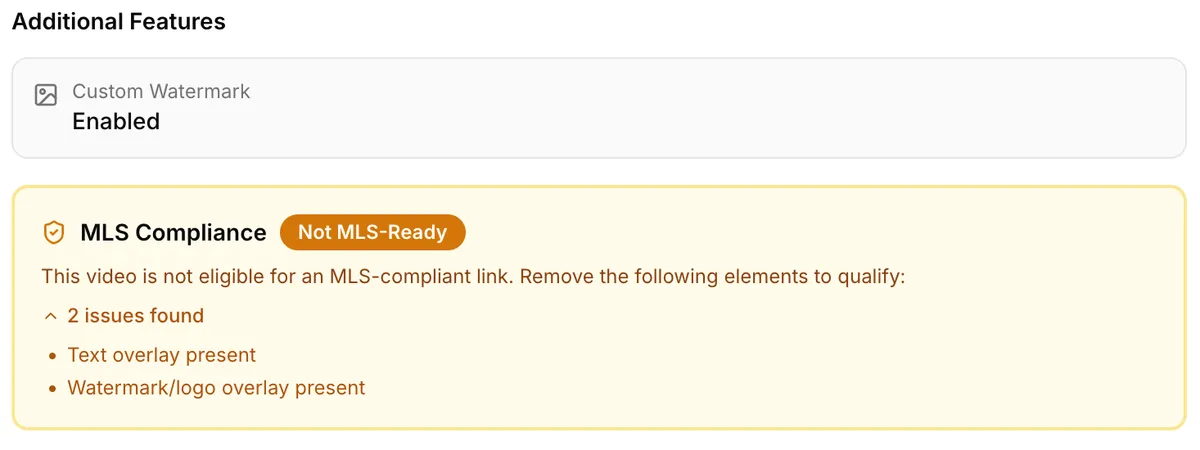
This is where the workflow matters, because doing all of the above by hand on every listing is how disclosures get skipped. When you export an MLS-compliant video in Reel Estate, the platform burns a disclosure banner directly into the frame that reads "AI Modified." That label is part of the rendered file, so it cannot be stripped the way a platform watermark can.
For still images, Reel Estate applies a per-edit label ("Virtually Staged" on staged rooms, "AI Modified" on other edits) and bundles a disclosure package on download: a ZIP containing the labeled image, the original unaltered photo, and a plain-text disclosure statement. That package maps directly onto AB 723's two requirements, the label and the accessible original, in one click. See how Reel Estate builds AI disclosure into export for the complete compliance workflow.
One honest caveat: a tool can apply the label and bundle the original, but you are still the responsible party. Reel Estate does not review or guarantee the compliance of your specific listing, and final legal sign-off on these rules should come from your MLS and counsel. The software removes the friction; the judgment stays with you.
If you produce listing video, the same standard applies end to end. See our overview of MLS-compliant video creation for how the compliance check fits into the export, and how to turn listing photos into a real estate video for the creation side.
The bottom line
Disclosure is no longer optional or informal. NAR has required it for years, most MLS boards enforce it, and California has now made non-disclosure a crime. The trend is one direction: more states, more formats, more enforcement.
The agents who stay ahead of this treat disclosure as a default setting, not a last-minute checkbox. Label the media, keep the original reachable, and use tools that do both automatically so it never gets forgotten on a busy listing day.
Ready to produce listing videos and staged photos that come with disclosure built in? Try Reel Estate's MLS-compliant export and stage your first listing on the free tier.
Originally published June 1, 2026; updated June 14, 2026 with state-by-state penalty detail. This article is general information, not legal advice; confirm current rules with your MLS and counsel.
Frequently asked questions
- Do you have to disclose virtually staged photos?
- Yes. Disclosure is required by the NAR Code of Ethics (Standards of Practice 12-5 and 12-10), most MLS boards, and a growing list of state laws. In California, AB 723 made non-disclosure of digitally altered listing photos a misdemeanor as of January 1, 2026. The safest rule: label every altered image and keep the original accessible.
- What does California's AB 723 require?
- AB 723 requires two things for any digitally altered listing image: a conspicuous statement on or adjacent to the image saying it was altered, and a link, URL, or QR code to the original, unaltered photo. It took effect January 1, 2026, and applies to agents, brokers, and anyone acting on their behalf. Routine edits like cropping or white balance do not count.
- Do I have to disclose AI-generated real estate videos?
- Treat AI video the same as altered photos. The NAR duty to present a true picture of the property applies regardless of format, and platform watermarks on synthetic video are easily stripped. The reliable approach is a disclosure label burned into the video frame, not just a caption, so it travels with the file wherever it is posted.
- Is a caption-only disclosure enough?
- Often no. Many MLS boards and AB 723 require the disclosure to appear on or directly adjacent to the image itself. A note buried in agent remarks or the photo caption alone is frequently not acceptable. Put the label on the media and back it up in the listing remarks.
- What happens if you do not disclose digitally altered photos?
- Consequences range from MLS fines and listing removal to ethics complaints under NAR Article 12. In California, AB 723 makes it a misdemeanor as of January 1, 2026, and the Department of Real Estate can issue a citation with a fine of up to $2,500 per violation. Undisclosed alterations can also expose agents to misrepresentation claims from buyers.
- Which states require disclosure of AI-altered real estate images?
- California (AB 723) and Wisconsin (Act 69, effective January 2027) have specific laws; New York's Department of State warns that misleading AI images already violate existing advertising rules; and Texas requires clear and conspicuous disclosure through TREC. Most other states rely on the NAR Code of Ethics plus local MLS policy. Penalties range from MLS fines to license discipline and, in California, a misdemeanor plus a DRE citation of up to $2,500 per violation.

Harrison Kaye · Co-Founder & CEO
Co-founder and CEO of Reel Estate and a licensed Texas real estate agent.