In short: AI-generated listing video carries the same disclosure duty as an edited photo, but it is the gap almost nobody is covering. The catch is that platform watermarks meant to flag synthetic video can be stripped in seconds, so the reliable disclosure is a label burned directly into the frame.
Every conversation about AI disclosure in real estate is about photos. Virtual staging, sky swaps, object removal. Meanwhile, agents are generating full listing videos from a handful of stills, and almost none of them are labeled. That is the open gap, and it is the one most likely to catch agents off guard as the rules catch up.
This is general information, not legal advice. Confirm the specifics with your MLS and your broker or attorney before relying on it.
Does AI-generated real estate video need to be disclosed?
Yes. The professional duty to present a true picture of the property applies the same whether your listing media is a photo or a video. The NAR Code of Ethics Article 12 obligation against misleading listing content does not stop at still images (National Association of Realtors, Case Interpretations Related to Article 12).
The reason it feels like a gray area is timing. Most state photo laws and MLS image policies were written before AI video was common, so they talk about "images" and "photographs." The duty did not narrow to exclude video; the rules just have not been rewritten yet. If an AI video changes how the property looks, treat it exactly like an altered photo and disclose it. For the photo side of this, see our guide to disclosing AI-generated listing photos.
Why AI video is harder to disclose than a photo
Two things make video the trickier case.
First, it is more convincing. A still image gives a buyer time to notice something is off. Motion does not. A smooth AI walkthrough reads as real footage, which raises the stakes on getting the disclosure right.
Second, and more important, the built-in safeguards do not hold. When OpenAI's Sora launched, testers found its AI watermark could be stripped in seconds with widely available tools (Inman, How AI Video Is Testing Our Trust, 2025). A caption can be dropped the moment a clip is reposted from the MLS to Instagram. If your disclosure lives anywhere except inside the video itself, it is one repost away from disappearing.
What the rules say about AI video
Three layers apply, the same stack as photos.
NAR. Article 12's true-picture duty covers video, full stop.
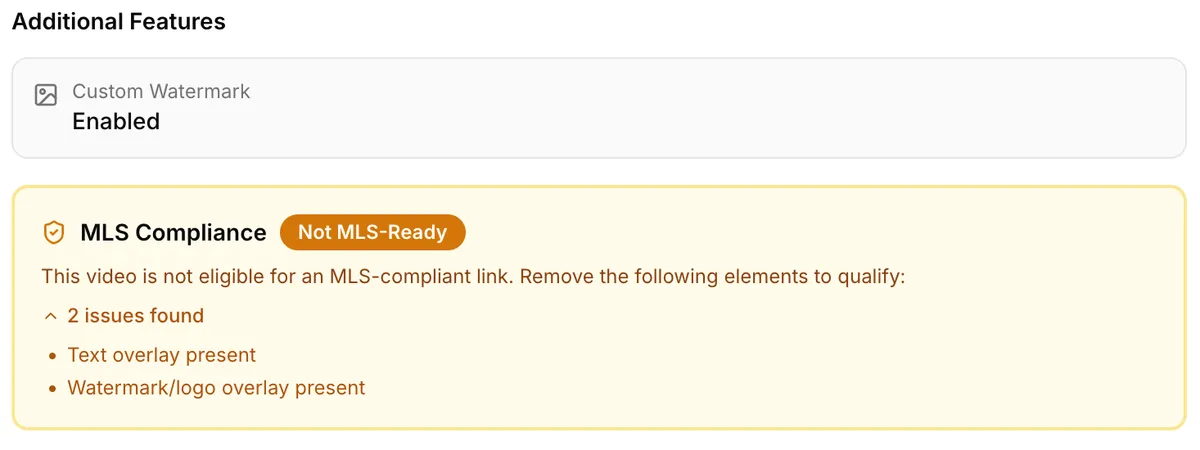
Your MLS. Beyond disclosure, MLS video rules usually prohibit branding, contact overlays, and background audio, so an AI video has to clear both the disclosure requirement and the formatting rules to be MLS-ready.
State law. Laws like California AB 723 are written around still images, so AI video sits under the broader NAR and MLS duty rather than the exact statutory text for now. That will not last; treating video like any other altered media keeps you ahead of it. There is also a Fair Housing layer: in 2024 HUD issued guidance confirming that AI-produced housing content can carry steering and discrimination liability, so disclosure is necessary but does not excuse content that misrepresents (HousingWire, HUD issues Fair Housing Act guidance on AI use, 2024).
For the full multi-state and multi-format picture, see our guide to virtual staging and AI video disclosure rules.
How to disclose AI real estate video correctly
The rule of thumb: put the disclosure where it cannot be removed.
- Burn the label into the frame. A statement like "AI-Generated" or "Virtually Staged Photo and Video" rendered into the video itself, not a caption or a platform watermark.
- Keep it through every export. The label has to survive when the file moves from the MLS to social.
- Note it in remarks. A secondary disclosure in the listing remarks, never the only one.
- Pass the MLS rules too. No branding, overlays, or background audio on the MLS cut.
This is the part we built Reel Estate around, after watching captions get dropped the moment a clip moved from the MLS to Instagram. When you export an MLS-compliant video, the platform burns an AI-Generated disclosure label into the rendered frame, so it travels with the file wherever it lands, and it checks the video against MLS formatting rules before you publish. The disclosure is part of the export, not a separate step you have to remember. See how Reel Estate handles MLS-compliant AI video export, or the real estate video product for the creation side.
The bottom line
AI video is the disclosure gap that has not closed yet, which makes it both a risk and an easy win. The duty already applies, the safeguards built into the tools do not hold, and the fix is simple: put the label inside the frame so it cannot be stripped. Do that, clear the MLS formatting rules, and you can use AI video without betting your license on a watermark.
Ready to produce listing video that exports compliant by default? Try Reel Estate and make your first video on the free tier.
Sources retrieved June 14, 2026. This article is general information, not legal advice; confirm current rules with your MLS and counsel.
Frequently asked questions
- Does AI-generated real estate video need to be disclosed?
- Yes. The duty to present a true picture of the property applies regardless of format, so AI-generated or AI-animated listing video carries the same disclosure obligation as an altered photo under the NAR Code of Ethics and MLS rules. Most rules were written for photos, but the obligation still applies to video.
- Why is disclosing AI video harder than photos?
- Two reasons. AI video is more convincing because motion reads as real, and the platform watermarks meant to flag synthetic video can be stripped in seconds with common tools. A disclosure that can be removed is not a reliable disclosure.
- How do you disclose an AI real estate video?
- Put the disclosure label inside the video frame, burned into the render, not just in a caption or a platform watermark. That way the label travels with the file to the MLS, Instagram, or anywhere else it is posted, and back it up in the listing remarks.
- Is a caption or platform watermark enough for AI video?
- Usually no. Captions can be dropped when a file is reposted, and platform watermarks have been shown to strip easily. The reliable approach is an in-frame label that is part of the rendered video itself.
- Does AI video have to be MLS-compliant too?
- Yes. Beyond disclosure, MLS video rules typically prohibit branding, contact overlays, and background audio. A compliant export has to clear both the disclosure requirement and the MLS formatting rules at the same time.

Jeff Goyette · Co-Founder & CTO
Co-founder and CTO of Reel Estate, building the AI video generation and staging product.