The 2026 AI Photo Disclosure Map: Which States Require What
AI makes it trivial to stage an empty room, brighten a lawn, or erase a power line. The law is catching up fast. An AI photo disclosure law now governs how you label those edits, and the rules depend on where you list.
Here is the honest headline. As of 2026, only two states have a dedicated real estate AI disclosure statute. Most enforcement still runs through MLS rules and long-standing truth-in-advertising ethics. This guide maps what actually applies, so your brokerage stays clean. It is a reference, not legal advice, so confirm the specifics with your MLS and your broker's counsel.
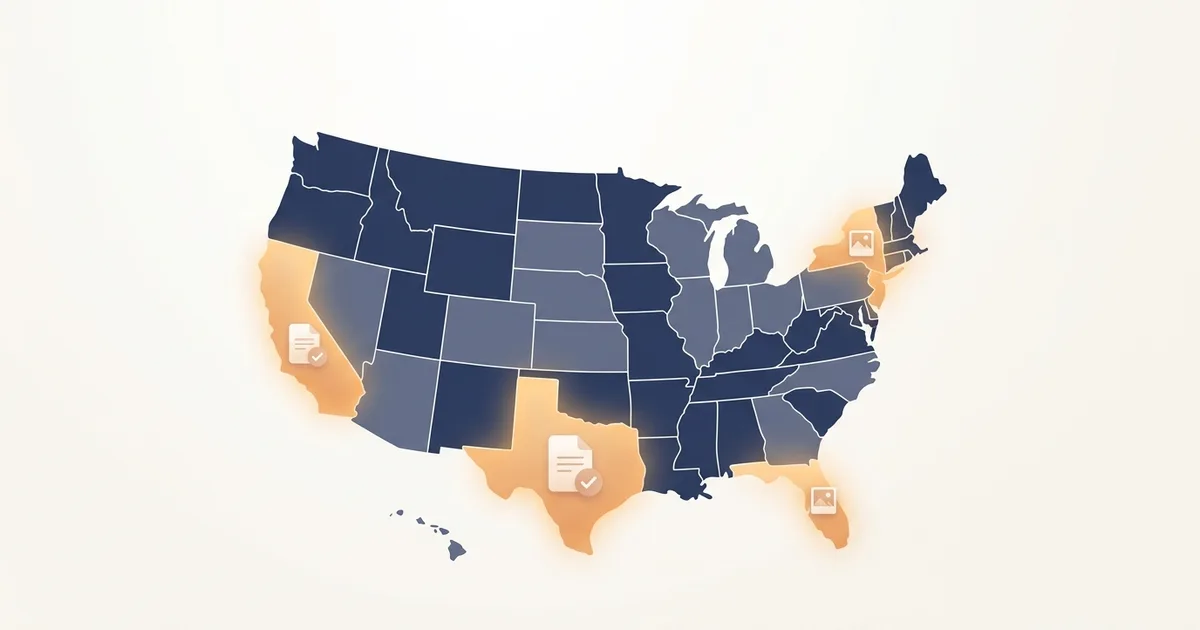
The 2026 landscape, at a glance
- Dedicated state laws: California and Wisconsin, and no others yet.
- General AI law or advisory: Texas and New York apply existing rules.
- MLS rules: several large MLSs now require disclosure directly.
- Nationwide baseline: the NAR Code of Ethics bars misleading advertising.
What an AI photo disclosure law actually requires
The core idea is simple. If you use AI to alter a listing image in a way that could mislead a buyer, you disclose it. The rules target edits that change what the property is: virtual staging, added or removed fixtures, or a digitally altered exterior.
A generic "images are for illustrative purposes" line no longer covers you. The dedicated laws want two things: a clear label on or beside the edited image, and access to the original, unaltered photo. Our overview of the AI disclosure rules explains the principle in depth.
Not every edit needs a label. Cosmetic corrections that keep the property honest, like brightness, white balance, or color, are generally fine. The line is misrepresentation. Adding a pool, erasing power lines, swapping a worn roof, or virtually staging an empty room all change what a buyer thinks they are getting, so each one needs disclosure. When in doubt, label it.
State laws that specifically target AI-altered photos
Two states have passed real estate AI disclosure statutes. Both focus on labeling edited images and preserving the original.
California: AB 723, effective now
California AB 723 took effect January 1, 2026. It requires a real estate licensee to disclose when a listing image has been digitally altered, and to make the original, unaltered image available to buyers. The label must sit on or immediately next to the image, and the edit must not misrepresent the property.
Enforcement runs through the Department of Real Estate. AB 723 sets no fine of its own, but the DRE can issue a citation of up to $2,500 per violation and can suspend or revoke a license (California Legislature, 2026). Our full AB 723 explainer walks through the details.
Wisconsin: Act 69, effective January 2027
Wisconsin is the second state to require it. Act 69 mandates disclosure of AI-altered listing images for one-to-four-unit residential property, and it takes effect January 1, 2027 (2025 Wisconsin Act 69). A good-faith safe harbor protects licensees who do not knowingly mislead. See the full Wisconsin Act 69 summary.
States with rules, but no dedicated AI photo law
Many states regulate misleading listing photos without a specific AI statute. Two matter most.
Texas: TRAIGA and TREC advertising rules
Texas passed the Responsible AI Governance Act, effective January 1, 2026. Notably, TRAIGA does not require labeling AI-edited listing photos. Its affirmative disclosure duties fall on government and healthcare use of AI (Texas TRAIGA summary). For listings, the Texas Real Estate Commission is the real enforcer, and it can penalize deceptive advertising under the Real Estate License Act. So the rule is old-fashioned: do not mislead.
A quick correction on a common myth. Some guides cite the Colorado AI Act as a photo rule. It is not. Colorado's law governs high-risk AI decision systems, like hiring and lending, and does not apply to listing photos.
New York: existing advertising rules apply
New York has no dedicated AI-image statute either. In November 2025, the Department of State warned that misleading AI-generated listing photos can violate existing advertising rules (New York DOS guidance). Licensees fall under Real Property Law 441-c, with fines up to $2,000 for dishonest advertising. Treat AI-altered New York listings as requiring disclosure.
MLS rules are where it bites right now
For most agents, the MLS is the first place a disclosure problem surfaces. Several large MLSs now require it directly:
- CRMLS (California, 110,000+ members): label altered images in the photo description and show the original beside them, under its Rule 11.5.2.
- SDMLS (San Diego): a label alone is not enough; the original must be viewable.
- Stellar MLS (Florida and Puerto Rico): disclose virtually staged photos in both the description and the public remarks.
- Bright MLS (Mid-Atlantic), NorthstarMLS (Minnesota), and NTREIS (Dallas-Fort Worth) carry similar rules.
Enforcement is getting more automated. MLS compliance teams increasingly flag the obvious tells of AI editing: a generated sky, an unnaturally green lawn, digitally removed power lines. A flagged listing can bring a correction notice, and repeat problems can put a hold on your data access.
Above all of this sits the NAR Code of Ethics. Articles 2 and 12 require truth in advertising, so an undisclosed, misleading AI edit can trigger a board sanction anywhere in the country.
What a compliant disclosure looks like
The dedicated laws point to a simple, repeatable practice. Build it into your listing workflow:
- Label the edited image. Put a clear note on or beside it, such as "virtually staged" or "digitally altered."
- Keep the original available. Provide the unaltered photo by link, QR code, or in the same gallery.
- Document your edits. Keep a record of what changed, and get the seller's sign-off on accuracy.
Some teams package these together: the original master photo, a ledger of edits, and a signed seller consent. That "disclosure packet" is not required by name, but it satisfies what the laws actually ask for. Reel Estate can attach a compliant AI-Generated label and export it to your listing, though you still confirm your own state and MLS rules.
The documentation matters as much as the label. If a buyer or a board ever questions a listing, an edit ledger and a signed seller acknowledgment show you disclosed in good faith. That record is what turns disclosure into a defensible process, rather than a judgment call you make photo by photo under pressure.
The 2026 disclosure map in one table
| Jurisdiction | What drives it | What it requires | Status |
|---|---|---|---|
| California | AB 723 (state law) | Label plus original available | Effective Jan 2026 |
| Wisconsin | Act 69 (state law) | Disclose AI-altered 1-4 unit photos | Effective Jan 2027 |
| Texas | TRAIGA plus TREC advertising rules | Do not mislead (no photo-label mandate) | Effective Jan 2026 |
| New York | DOS guidance plus advertising rules | Do not mislead; disclose | Advisory, 2025 |
| Major MLSs | MLS photo rules | Label plus show the original | Effective 2026 |
Stay ahead of the rules
The map will keep changing. California and Wisconsin are first, not last, and MLS rules are spreading faster than statutes. The safe habit is the same everywhere: label AI edits clearly, keep the original within reach, and never alter a photo in a way that misleads. Check your state and MLS on the full AI disclosure regulations map before your next listing goes live.
Sources
- California Legislature, Assembly Bill 723, retrieved 2026-07-07, https://leginfo.legislature.ca.gov/faces/billNavClient.xhtml?bill_id=202520260AB723
- 2025 Wisconsin Act 69 (official text), retrieved 2026-07-07, https://docs.legis.wisconsin.gov/document/acts/2025/69.pdf
- Texas HB 149 (TRAIGA), enrolled text, retrieved 2026-07-07, https://capitol.texas.gov/tlodocs/89R/billtext/html/HB00149F.htm
- New York Real Property Law 441-c, retrieved 2026-07-07, https://www.nysenate.gov/legislation/laws/RPP/441-C
- CRMLS Knowledgebase, Digitally Altered Images (Rule 11.5.2), retrieved 2026-07-07, https://kb.crmls.org/knowledgebase/digitally-altered-images-faqs/
Frequently asked questions
- What triggers an AI photo disclosure law?
- Using AI to alter a listing image in a way that could mislead a buyer, then failing to label it. That covers virtual staging, added or removed fixtures, and digitally changed exteriors. California's AB 723 requires both a clear label and access to the original photo.
- Which states actually have an AI photo disclosure law?
- As of 2026, two: California, under AB 723 effective January 1, 2026, and Wisconsin, under Act 69 effective January 1, 2027. Every other state relies on existing advertising rules, MLS rules, and the NAR Code of Ethics rather than a dedicated AI-image statute.
- Does the Colorado AI Act cover listing photos?
- No. Colorado's AI Act governs high-risk AI decision systems, such as hiring and lending. It does not regulate real estate marketing images, so do not treat it as a photo-disclosure rule. Some guides cite it incorrectly.
- Does an 'images are illustrative' disclaimer satisfy the rules?
- Generally no. California AB 723 and most MLS rules want a clear label on or beside the altered image, plus access to the original, unaltered photo. A generic catch-all line does not meet that standard.

Harrison Kaye · Co-Founder & CEO
Co-founder and CEO of Reel Estate and a licensed Texas real estate agent.