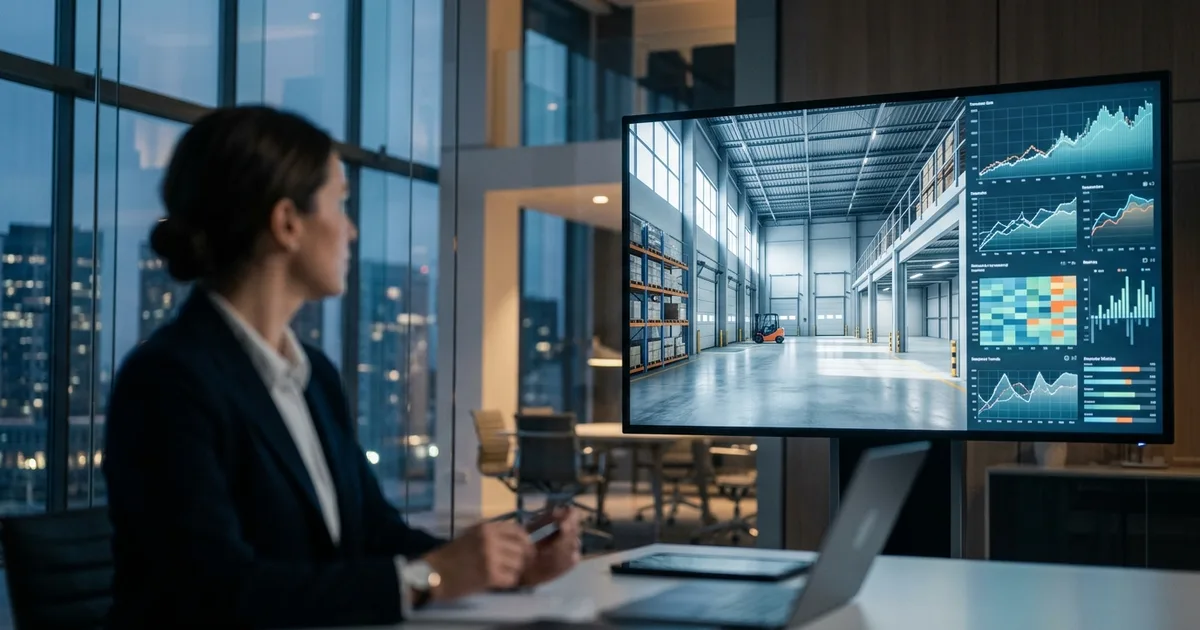
Commercial Real Estate Video: What Investors Want to See
Institutional investors do not buy buildings the way homebuyers buy houses. They buy cash flows, lease durability, and the absence of nasty surprises. So a commercial real estate video built like a residential tour, with sweeping drone shots and warm music, misses its audience. The people writing eight-figure checks want data, not mood.
That gap is an opportunity. Capital is selective right now. CBRE expects U.S. commercial real estate investment to recover by up to 10% in 2025, but with borrowing costs still high, buyers underwrite hard and pass fast (CBRE, 2025). A commercial real estate video that answers underwriting questions up front helps your asset clear the first cut. This guide covers what belongs in one, and how to produce it.
The fundamentals reward differentiation. In mid-2025, U.S. office vacancy sat around 14.1% and industrial net absorption hit a decade low, even as multifamily stayed the bright spot (NAR, 2025). When space competes for scarce, cautious capital, a listing that explains itself clearly has the edge.
The five underwriting anchors, at a glance
- Clear height and loading. Ceiling clearances, dock doors, and truck access.
- Tenant divisions. How the space is demised, and by whom.
- Mechanical and plant. Chillers, switchgear, and HVAC condition.
- Ingress and egress. Site access, parking, and traffic flow.
- CapEx proof. Roof, structure, and system condition, on camera.
Why residential-style videos fail commercial buyers
The core mistake is selling aesthetics to a financial audience. A residential video leads with light, finishes, and lifestyle. An institutional buyer scrolls past all of it. None of it underwrites the deal. Investors weigh net operating income, lease terms, and physical risk. A video that ignores those reads as marketing fluff.
This is not just taste. In B2B video broadly, educational and information-dense formats earn the most engagement (Wistia, 2025). An underwriting-focused tour is exactly that kind of content.
There is a trust dimension too. Sophisticated buyers treat a heavily polished montage with suspicion. A cinematic edit can look like an attempt to hide deferred maintenance or an awkward tenant layout. Raw, well-lit footage of the actual systems does the opposite. It signals that the seller has nothing to conceal.
It helps to be honest about what video does here. It is not a lead machine. It is a comprehension and trust tool. It answers questions faster than a written offering memorandum, and it earns the meeting. That is the right expectation to set.
A few residential staples actively work against a commercial asset:
- Background music. It adds nothing an underwriter values and reads as a distraction from the numbers.
- Slow cinematic drone montages. Save the sweeping establishing shot. Lead with the loading dock and the clear height.
- Lifestyle B-roll. Coffee cups and sunset patios sell a home, not a cap rate.
Cut those, and every second you keep is doing underwriting work.
What belongs in an investor-facing commercial real estate video
Treat the video as a visual companion to the underwriting model. Every scene should map to a number a buyer cares about.
Put the lease economics on screen
Overlay the financials directly on the footage. As the camera moves through each tenant space, show the metrics that define its value:
- Net leasable area and current rent per square foot.
- Weighted average lease term, or how long the income is locked in.
- The triple-net expense structure and the tenant's credit quality.
A buyer should be able to connect the space to its income without opening a spreadsheet.
Keep the numbers current and tied to the actual leases. A stale rent figure does more harm than no figure at all. It invites doubt about everything else in the file. Label each overlay as in-place income, not a pro-forma hope, so the buyer trusts what they see.
Show the spatial realities
Commercial buyers read space in measurements, not impressions. Capture and label the specifics that drive use and value: clear height under the joist, column spacing, slab condition, and roll-up door dimensions. For industrial assets, dock count and truck-court depth matter more than any interior finish.
Measurements settle arguments. A buyer who can read clear height and column spacing off the screen can rule your asset in or out. No site visit needed. For flex and retail, show frontage, parking ratios, and how visible the signage is from the road. Those details decide use, and use decides value.
Verify the mechanical plant and CapEx
This is where raw footage earns its keep. Walk the chiller plant, the electrical switchgear, and the roof. Show the real condition of the systems that carry the building's biggest capital risks. Where a warranty or a recent replacement applies, note the date on screen. You are pre-answering the questions a physical inspection will raise.
Age and condition drive the capital budget, so do not skip the unglamorous rooms. A ten-year-old roof with three years of warranty left is a very different underwrite than one at the end of its life. The video is where you get to show which one you actually have.
How to produce it
A strong commercial real estate video is planned like an underwriting file, not a highlight reel.
- Script from the rent roll. Map the walkthrough to the property's income. Each tenant space gets its own segment, with clean captions on lease terms and escalations.
- Use the right kit. Wide, low-distortion lenses keep proportions honest. Bring field lighting for dark utility vaults. Use drone footage to show parcel boundaries, parking, and road access.
- Build data sidebars. In the edit, add clean graphic panels for net operating income, cap rate, and a pro-forma IRR range. Our guide on how to create stunning real estate videos covers the production workflow.
- Chapter it. Break the video into labeled sections with timestamps, so an underwriting team can jump straight to the mechanical systems or the tenant space they need.
A workable chapter structure fits most assets:
- Site and access: drone view, parking, and ingress.
- Exterior and building envelope.
- Tenant spaces, walked in rent-roll order.
- Mechanical, electrical, and roof.
- The numbers: net operating income, cap rate, and the pro-forma range.
If you are starting from a photo set and a site plan, you can turn existing property media into a video and layer the data on top.
Get it in front of the right investors
Distribution for a commercial asset looks nothing like a residential listing. You are not chasing public portal traffic. You are reaching a defined set of qualified buyers.
Send the video through the channels investors already use. Embed it in the deal room alongside the offering memorandum. Drop it into targeted investor email and your firm's direct outreach. For broader reach, LinkedIn is the dominant B2B video channel, named the primary place to share video by about 81% of teams in Wistia's research (Wistia, 2025). Educational, information-dense videos consistently earn the most engagement, which is exactly what an underwriting-focused asset delivers.
Keep the asset yours. A commercial real estate video you control can move from deal room to email to a private channel without depending on any public aggregator.
Underwrite the video like the deal
Investors give a listing seconds before they decide to dig in or move on. A commercial real estate video that leads with cash flow, lease economics, and honest footage of the physical plant respects that reality. Build it like an underwriting file, distribute it to buyers you have chosen, and it does what a glossy montage never will: it earns the LOI. Ready to build one? Start with commercial real estate marketing that speaks the investor's language.
Sources
- CBRE, 2025 U.S. Real Estate Market Outlook (investment recovery), retrieved 2026-07-07, https://www.cbre.com/press-releases/investment-recovery-to-gain-momentum-despite-interest-rates-remaining-higher-for-longer
- NAR, July 2025 Commercial Real Estate Market Insights, retrieved 2026-07-07, https://www.nar.realtor/research-and-statistics/research-reports/july-2025-commercial-real-estate-market-insights
- Wistia, State of Video Report (video marketing statistics), retrieved 2026-07-07, https://wistia.com/learn/marketing/video-marketing-statistics
Frequently asked questions
- Why do residential-style real estate videos fail with commercial buyers?
- Residential videos sell lifestyle, light, and finishes. Commercial buyers decide on net operating income, lease economics, and structural risk, so emotional edits read as fluff. A montage with no data gives an investor nothing to underwrite, and they move on.
- What do commercial buyers look for in a property video?
- Hard specifics and potential liabilities. They want clear height under the joist, roof condition, loading-dock flow, electrical capacity, column spacing, and site ingress and egress. They are checking for deferred maintenance as much as for selling points.
- How do you show value in a commercial property on video?
- Overlay the lease economics on the footage. As the camera moves through each space, display net operating income, triple-net escalations, weighted average lease term, and tenant credit next to the physical rooms. Connect the space to its income without a spreadsheet.
- How long should an institutional commercial real estate video be?
- About three to five minutes, broken into clear chapters with timestamps. Busy underwriting teams do not watch linearly. They jump straight to the mechanical systems or the tenant space they need to verify, so label the sections.

Jeff Goyette · Co-Founder & CTO
Co-founder and CTO of Reel Estate, building the AI video generation and staging product.